Raman Spectroscopy for knowledgeable people who don’t yet know how awesome Raman spectroscopy is.
Welcome to our page! If you are here, we can assume that you would like to understand what Raman spectroscopy is and how it can be used in your industry or research. Do not worry, we will explain the most important aspects of the technique and how it may help you achieve your goals.
We will build your knowledge step by step, starting from simple concepts. By the end of the series, we will go deeper and provide more precise, technical information.
So, let’s start with the very basics:
What is Raman spectroscopy?
Raman spectroscopy is an analytical technique used to identify materials and study their molecular structure. When you perform a Raman measurement, the instrument records a spectrum that shows the “chemical fingerprint” of the sample.
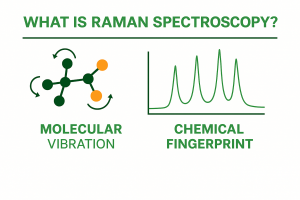
This fingerprint is unique because every material has its own set of molecular vibrations, and these vibrations produce a specific pattern of peaks in the Raman spectrum.
Raman spectroscopy is used for many applications, with chemical identification and structural analysis being the most common ones. Now that we’ve covered the idea, let’s go a bit deeper into how it works.
How does Raman spectroscopy work?
Many online articles explain the physics in detail, but our goal here is to make it understandable regardless of your academic background. A more advanced version of these chapters will cover the deeper science later.
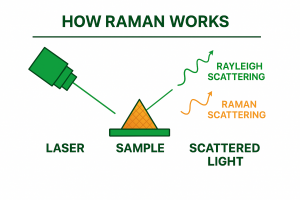
But basically, we have a laser that irradiates a material, this creates a “response” that contains the fingerprint of that material that can be read and analysed by a powerful camera that is attached to a spectrometer.
Let’s begin with the basics.
Raman uses light to identify materials, but not just any light. Raman instruments require monochromatic light, meaning it must have a single, very precise wavelength. This is achieved using lasers with extremely narrow bandwidths (the narrower the better, though also more expensive).
Lasers used in Raman can be different colours (or wavelengths): for example, green (532 nm), yellow (578 nm), or red (630 nm/785 nm).
The interaction with the sample
A laser beam is directed onto the sample. When the light hits the molecules:
Most of the light is elastically scattered, this is called Rayleigh scattering. It contains no Raman information.
A very small fraction is inelastically scattered, this is Raman scattering and contains information of the fingerprint of the material we are illuminating with the laser. This is the part we want and we separate to analyse.
During Raman scattering, the energy of the incoming photons interacts with the molecule’s vibrational and rotational states. This interaction causes the scattered photons to shift in energy (sometimes higher, sometimes lower). That shift is what creates the Raman signal.
Collecting the Raman spectrum
The Raman spectrometer rejects the Rayleigh scattering (no information) and collects the scattered light and separates it into its wavelengths, much like a prism splitting white light into colours. A sensitive detector then measures these tiny changes.
These appear as bands or peaks in a graph, that is what we call the Raman spectrum. Each molecule has its own unique set of vibrational modes, so its spectrum acts like a fingerprint. This is why Raman is often called a “spectroscopic fingerprint” technique.
Frequently Asked Questions
Yes, as long as proper laser‑safety procedures are followed. Raman instruments use lasers (typically 405–785 nm) that can be hazardous to eyes if misused (they are classified as laser class 3B, these require to be use with safety goggles, refer to your local regulations regarding the correct use of equipment’s with class 3b lasers). There is no skin risk or any other type of radiation. Modern devices include multiple safety features such as interlocks, making accidental exposure extremely unlikely.
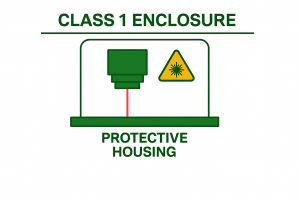
To improve safety further, many systems use Class 1 enclosures, which fully contain the laser path and make the instrument safe under normal use.
Different laser wavelengths interact differently with samples.
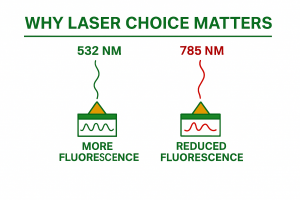
The choice affects fluorescence, signal strength, penetration depth, and heating. Selecting the correct wavelength helps avoid sample damage and improves spectral quality. There is a broad selection of laser wavelengths on the Raman devices, but at the end, the large majority of users works with 532nm (green) or 785nm (red-NIR) lasers. About 80% of all Raman units worldwide use these lasers lines.
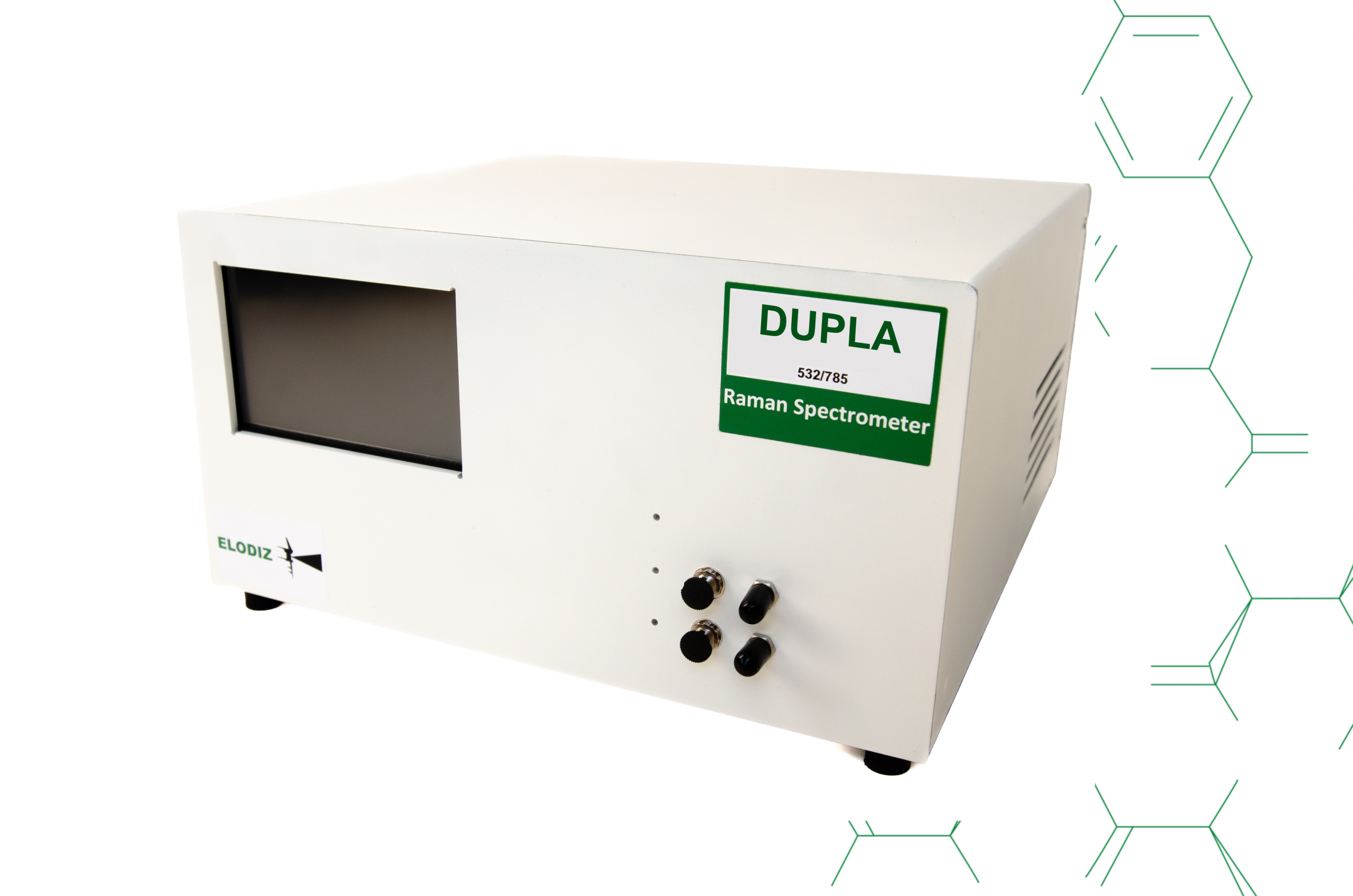
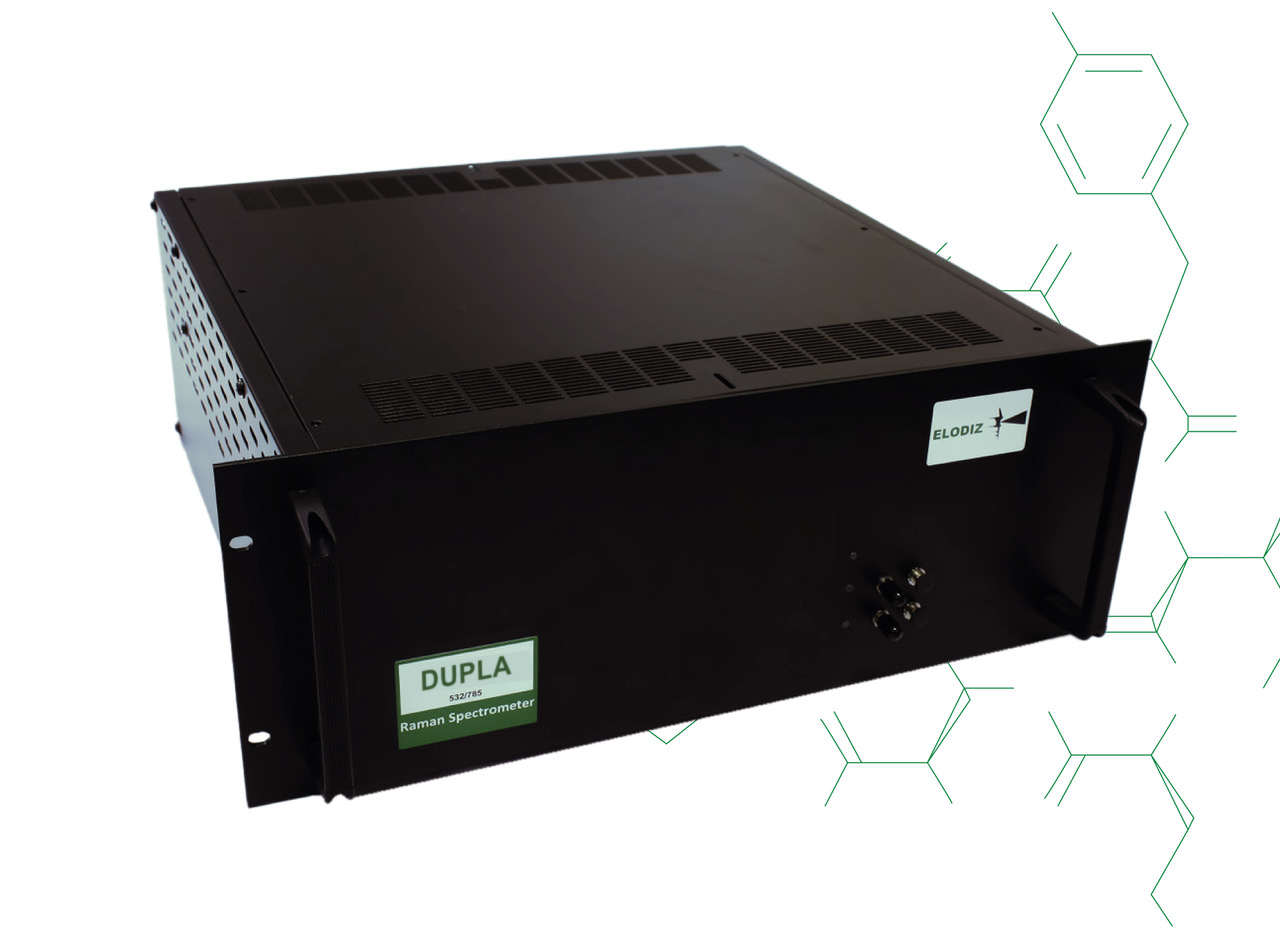
ELODIZ NEEGALA™ includes two wavelengths in one system (532 and 785!!!), allowing easy switching between them depending on the application, just select the laser line that it is adapted the best for your application: stronger signal (532), lower fluorescence (785), better resolution(785), broader spectral range (532), etc.
Raman works well with many types of materials: organic and inorganic chemicals, solids, powders, crystals, aqueous samples, packaged materials, hazardous or unknown substances, and more.
Raman is broadly use in many industries and areas, such as, polymer, pharmaceuticals, reaction monitoring for chemicals, petrochemical plants, forensic laboratories, bioreactors, medical devices, etc.
Materials that do not work include metals (any) and substances without vibrational modes (e.g., salt).
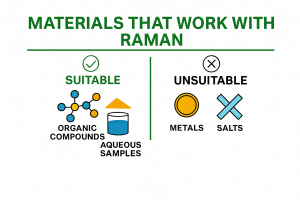
Some samples are a bit difficult to predict, due to the problem of fluorescence, hence the options to select laser lines. Some black or colourful samples could be in general difficult to analyse as they absorb the light.
A Raman spectrum is a graph showing peaks:
x‑axis: Raman shift (cm⁻¹), representing vibrational energy.
y‑axis: Signal intensity, influenced by factors like concentration.
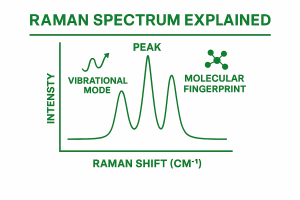
Each peak corresponds to a specific molecular vibration. The pattern of these peaks is unique to each material, forming a spectral fingerprint that defines the specificity of this technique. This means Raman spectroscopy can be used for both qualitative and quantitative analysis. When a spectrum is taken, it is compared with known reference spectra stored in libraries to identify or confirm a material.
If you see a very broad band with little or no visible peaks, this could be an indication that your sample presents fluorescence, which can mask the Raman signal.
No. there are big machines, normally associated to microscope systems and these are for laboratory only, but in the other hand we have portable devices, for applications like police forces.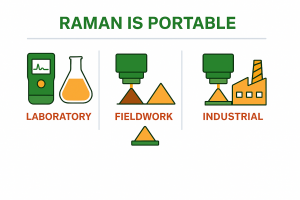
Raman instruments can be as well portable or small footprint. ELODIZ instruments are of a small footprint, so you can take measurements wherever needed and can be move around, so it not just lock in a laboratory bench.
Rarely, and only under specific conditions. The laser can heat or damage sensitive materials, especially dark or organic ones.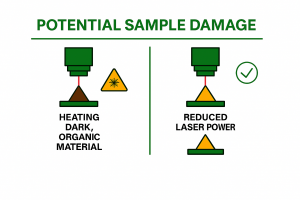
Raman systems allow users to reduce laser power or adjust focus to avoid damage. In general, Raman is a fingerprint technology considered non-destructive, that is why is often used in many applications like pharmaceutical or forensic laboratories.
Definitely Yes!!!!!
Qualitative: Each substance has a unique fingerprint, but you need to create a library, you can have a quick look at https://data.elodiz.com/spectra/ where there is a basic library for you to take a look.
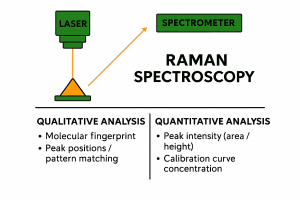
Quantitative: Peak intensities increase with concentration, enabling calibration‑based quantification. You will need to create some kind of model to correlate spectrum with quantities, but it is not hard work.